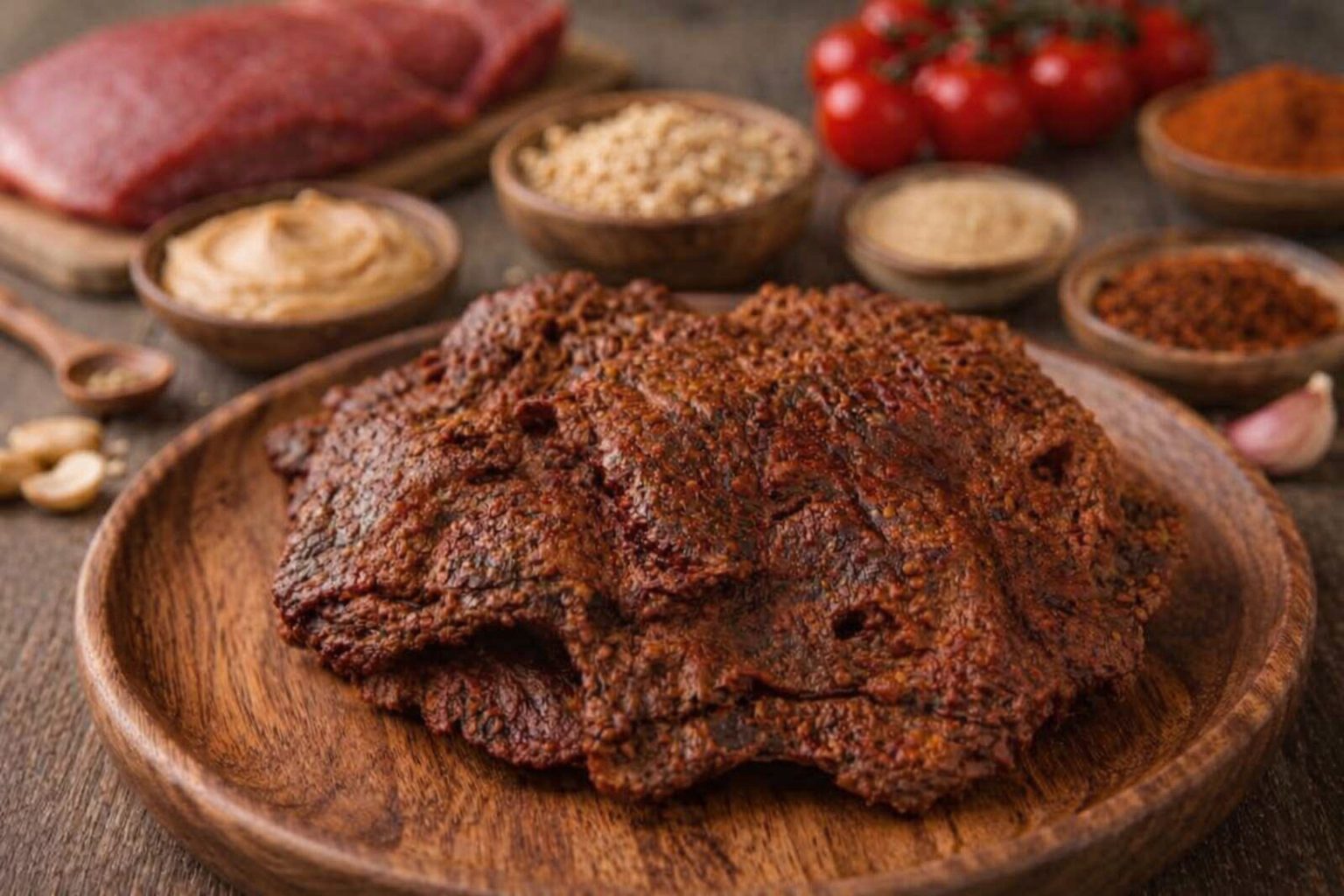
Seventy-two hours. Two pairs of hands. One recipe that hasn’t changed in centuries. Inside the FLANDEX kitchen the cycle starts Tuesday morning and doesn’t end until Friday evening — and every batch carries the smell of roasted peanut, hardwood smoke, and the kind of patience modern food has forgotten. Step inside.
People ask why Kilishi can’t just be made in an afternoon like American jerky. The short answer: it isn’t jerky. It’s a different food, with a different process, that resists shortcuts. Speed it up and you don’t get faster Kilishi — you get a different thing, and a worse one. Here’s how FLANDEX actually makes it, step by step, in a USDA-inspected kitchen in Maryland.
Day 1, Morning — Selecting and Slicing the Beef
Kilishi lives or dies on the meat selection. Calvin starts with lean cuts of US beef — the leaner the better, because fat doesn't dry well and turns rancid quickly. Tough working cuts work best: the connective tissue softens during the long dry and adds depth.
The slicing is where craft enters. Every piece is cut thin enough to see light through — roughly one to two millimeters. There's no shortcut here. Sliced too thick, the seasoning won't penetrate and the inside stays raw-flavored. Sliced too thin, the meat tears apart during coating. Years of practice live in this step.
Day 1, Afternoon — Making the Labu Paste
While the meat is being sliced, the seasoning paste is made fresh. The traditional name for it is labu. It contains:
- Roasted groundnuts — the foundation of the crust
- Ground chili — how Mild, Spicy, and Extra Hot get differentiated
- Ginger — fresh, ground
- Garlic — fresh, ground
- Onion — for depth
- Salt — for cure and flavor
The peanuts are roasted in-house and ground into a paste with the other aromatics until it's the consistency of thick peanut butter. No sugar. No liquid smoke. No commercial flavor packets.
Day 1, Evening — Hand-Coating Every Slice
This is the slowest part of the process. Every thin slice of beef is individually coated with the labu paste, by hand, on both sides. There's no machine that does this well — the slices are too thin and the paste is too sticky.
The coated pieces are laid flat on racks, not touching each other, so air can move around them.
Day 2 — The First Long Dry
The racked slices sit in low, even heat for the entire second day. The point isn't to cook the beef — it's to dry it slowly while letting the labu bond to the surface. As moisture leaves the meat, the paste tightens onto the slice and starts forming the crust that defines real Kilishi.
Temperature and air movement matter enormously here. Too hot and the outside hardens before the inside dries, trapping moisture and ruining the texture. Too cool and food-safety becomes a problem.
Day 3 — The Final Dry
By day three the slices have lost most of their water. The texture is firm but still pliable — not snappable like a chip, not chewy like soft jerky, but something in between. The peanut crust is now fully bonded to the meat. Each piece is checked individually before it goes into a 3 oz pouch.
The USDA Layer
Traditional Kilishi in West Africa is often made over open fires in market stalls. FLANDEX produces in a USDA-inspected facility, which adds requirements traditional makers don't deal with — documented sourcing, temperature logs, sealed packaging, allergen disclosure, batch tracking. It's slower and more expensive than a home kitchen, but it's what allows the product to be sold legally across the US, shipped through Etsy and Amazon, and stocked on store shelves.
Why It Can't Be Rushed
The 3-day timeline isn't a marketing story — it's structural. Skip a day and the labu doesn't fully bond. Skip the hand-coating and the crust comes out uneven. Use thicker slices to save time and the inside tastes raw. Use cheaper meat and the texture suffers. Every shortcut shows up in the finished bag.
That's why a 3 oz pack of FLANDEX Kilishi costs what it does, and why people who grew up eating Kilishi recognize it when they taste it.
"The most authentic kilishi I have had, and it always arrives in two days. I will keep repurchasing." — Verified Etsy customer
Try the Result
The three FLANDEX heat levels — Mild, Spicy, and Extra Hot — all use the same 3-day process. Only the chili level changes between them.
If you're curious about the nutrition side — protein, fat, allergens, what the slow dry actually preserves — the next post in the series breaks it down: Is Kilishi Healthy? Nutrition, Protein, and Allergens Explained.